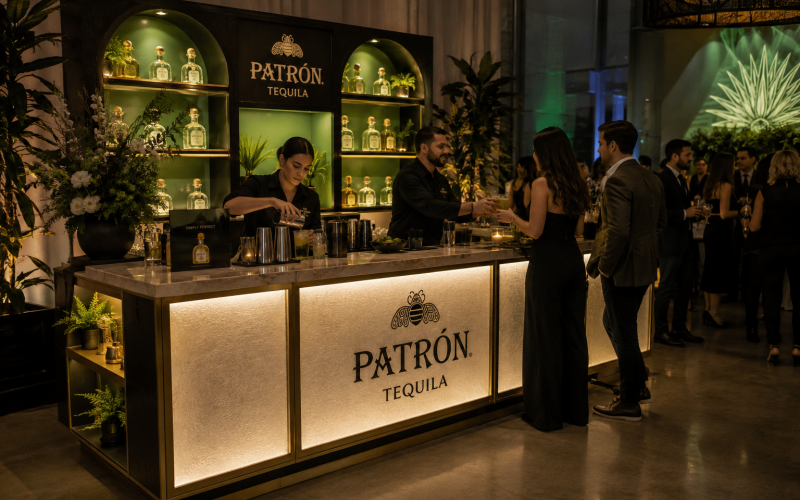
A branded bar display has to do more than look good in a rendering. It needs to serve guests quickly, hold up through a busy event schedule, fit the venue’s access constraints, and put the brand in every photo taken across the bar. Knowing how to fabricate branded bar displays starts with treating the unit as an operational event environment, not simply a decorated counter.
For product launches, sampling programs, trade show hospitality, and pop-up activations, the bar is often the highest-traffic point in the footprint. Small production decisions – counter height, storage access, cable routing, graphic protection, and breakdown sequence – can determine whether the activation runs cleanly or creates friction for staff and guests.
Start With the Bar’s Job at the Event
Before selecting materials or approving a finish, define what the bar needs to accomplish. A cocktail-service bar has different requirements from a sampling counter, coffee station, retail checkout, or lead-capture hub. The service model drives the footprint, work surface, storage, power needs, and guest flow.
Ask how many staff members will work behind the bar at one time, what products they will serve, and how much backstock must be stored onsite. A compact branded display may be appropriate for a trade show aisle, while a high-volume festival bar needs more landing space, larger internal storage, and durable surfaces that can handle ice bins, spills, and constant cleaning.
The guest-facing side also needs a clear role. It may carry a hero logo, an illuminated product image, a menu, or a dimensional brand element. Avoid asking one surface to communicate everything. A strong fabrication plan establishes a visual hierarchy so the brand remains recognizable from across the room without overwhelming the service interaction at close range.
How to Fabricate Branded Bar Displays Around a Proven Structure
The structural approach should match the campaign’s lifespan and logistics. For a one-city event, a lightweight modular system with replaceable graphics may be the practical choice. For a national activation tour, investing in a durable, repairable custom product often protects the program budget over repeated deployments.
A typical branded bar display begins with an internal frame or cabinet structure built to support the counter, face panels, equipment, and any added signage. Aluminum extrusion can reduce weight and support modular configurations. Wood-based cabinetry provides a solid, furniture-grade foundation for custom forms and premium finishes. Steel may be appropriate for narrow profiles, long spans, or industrial design concepts, but it adds weight and requires careful finishing.
The counter surface deserves special attention. It must be level, easy to clean, resistant to normal service wear, and sized for the actual tools the team will use. Laminates, solid surfaces, sealed wood, acrylics, and metal each have a place. The right choice depends on the desired look, exposure to moisture, expected use, and whether the asset will travel frequently.
Build for real conditions, not just the show floor photo. Reinforce stress points around casters, service openings, and countertop overhangs. Use concealed hardware where possible, but make critical components accessible for repair. If the display will be shipped, design panels and corners to withstand handling rather than assuming the crate will solve every impact risk.
Design for Service Access and Staff Movement
A polished exterior cannot compensate for a difficult work zone. Inside the bar, staff need room to move, restock, dispose of waste, and reach supplies without opening a guest-facing panel. Include shelves, lockable storage, removable bins, and equipment clearances early in the design process.
If the unit requires refrigeration, sinks, water lines, or specialty equipment, coordinate those requirements before fabrication begins. These details affect internal dimensions, ventilation, weight distribution, power requirements, and venue approvals. For beverage programs involving alcohol, local service rules, permits, and health requirements can also affect the final configuration.
Choose Branding Methods That Survive the Event
The fastest way to weaken a premium bar is to apply graphics that wrinkle, peel, glare under event lighting, or scuff after one load-in. Branding should be selected based on the display material, event duration, travel plan, and desired visual effect.
Printed vinyl is useful for interchangeable campaign graphics and short-term updates. It can be applied to smooth, prepared surfaces and replaced when a message changes. Direct print and laminated graphic panels provide a more durable option for repeated use. Dimensional logos, routed acrylic lettering, raised metal elements, and illuminated marks add depth when the bar needs stronger presence in a crowded environment.
Consider sightlines before finalizing the graphic package. A front logo may be highly visible in a trade show booth but blocked by a queue at a public activation. Side panels can carry messaging visible from approach paths. A barback, overhead sign, or lit brand element may be needed when the counter itself sits below the audience’s eye level.
Color matching should be controlled across all components, especially when paint, printed graphics, acrylic, fabric, and lighting appear in the same build. Request approved color references and test samples when brand standards are strict. A close approximation can look noticeably wrong under bright convention-center lighting or warm evening event lighting.
Integrate Lighting and Power Early
Lighting can turn a standard bar into a focal point, but it needs to be engineered into the fabrication plan. LED edge lighting, under-counter illumination, backlit logo panels, and internal shelf lighting can all improve visibility and atmosphere. They also introduce power supplies, ventilation needs, cable paths, access panels, and setup requirements.
Avoid exposed cords crossing service areas or guest walkways. Build cable management into the bar, identify where power enters the unit, and confirm that the venue can provide the required circuits. For outdoor or temporary environments, specify components suited to the anticipated conditions and protect connections from moisture and foot traffic.
Lighting should support the brand rather than compete with it. Bright, cool illumination may fit a technology launch, while a hospitality-focused experience may call for warmer accent lighting. Test the effect with the actual graphic materials whenever possible. Some finishes reflect light aggressively, while others absorb it and need more illumination to read clearly.
Make Transport and Setup Part of Fabrication
The event team should not encounter the first assembly challenge during load-in. A fabrication-ready design includes a transportation and setup strategy from the beginning. Determine whether the bar needs to fit through standard doors, freight elevators, loading docks, or narrow venue corridors. Measure the largest assembled components against those limitations.
For touring programs, modular sections can reduce handling risk and allow the display to adapt to different footprints. The trade-off is that more sections mean more seams, hardware, and assembly time. A single-piece bar can look exceptionally clean but may demand specialized freight, larger crews, and more difficult venue access.
Label components clearly and create a straightforward assembly sequence. Pack hardware in dedicated, labeled kits. Custom crates, padded covers, and protective corner treatments extend the life of finished surfaces, especially for branded panels that cannot be easily replaced onsite. Include spare touch-up materials or replaceable graphic elements when the campaign will travel for multiple stops.
Validate the Build Before It Reaches the Venue
A pre-event quality check is where fabrication becomes dependable event execution. Assemble the complete bar before shipping when the schedule allows. Confirm that doors open, panels align, graphics match approved art, lighting functions, and all required equipment fits in place.
Test the display from the guest perspective and the staff perspective. Is the logo readable at distance? Can a team member reach inventory without disrupting service? Are sharp edges, unstable components, and exposed hardware addressed? Does the bar still look intentional when surrounded by bins, product, menus, and point-of-sale equipment?
For brands and agencies managing complex activations, the fabrication partner should be involved early enough to flag issues that creative renderings cannot reveal. Portadecor approaches custom bars as activation assets that need to perform under event conditions, from fabrication and branded finishes through transportation, installation, and repeated use.
The best branded bar display earns attention without slowing the people working behind it. When structure, graphics, service workflow, and logistics are planned together, the result is not just a branded counter. It is a reliable interaction point that gives guests a reason to stop and gives the brand a stronger presence in the room.