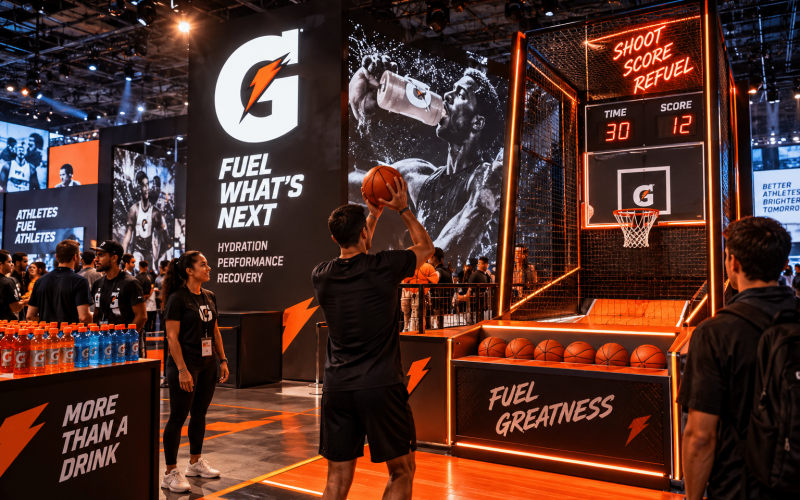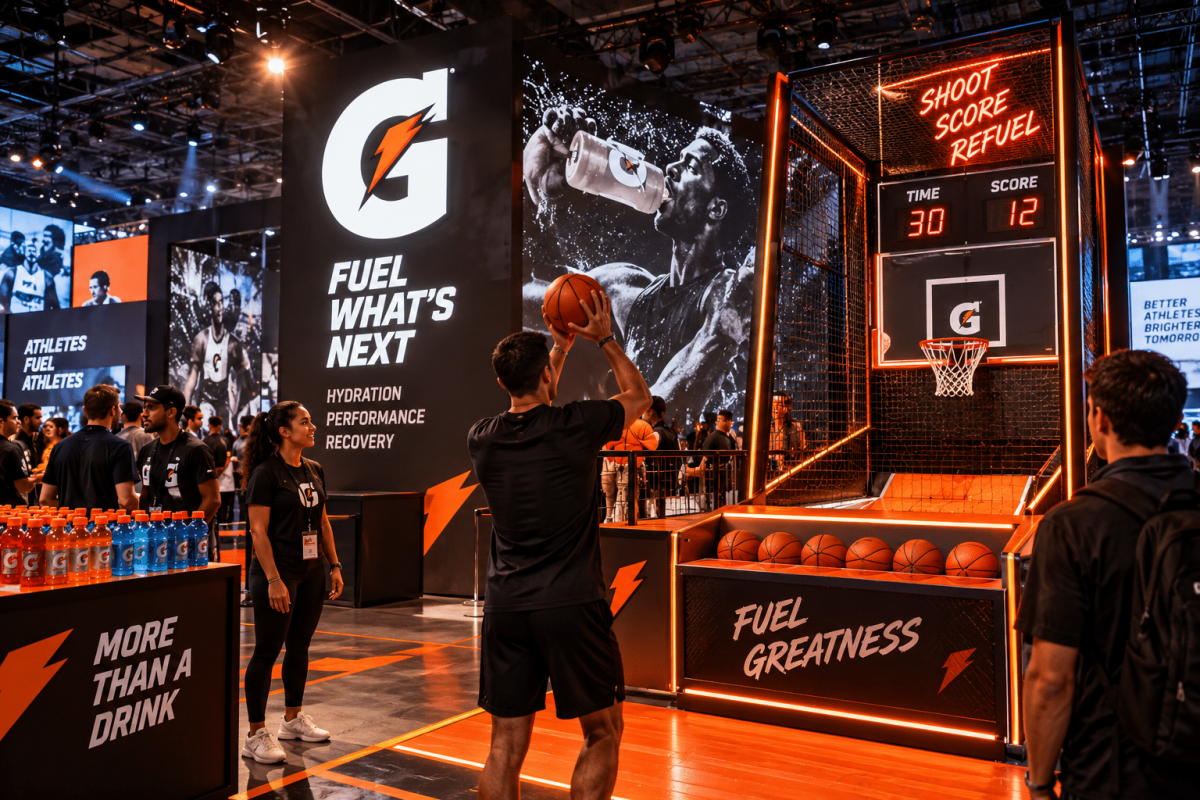
A packed booth is not automatically a productive booth. The question is which booth games attract leads who have a reason to speak with your team, remember the experience, and move into a follow-up conversation. The best game is not simply the loudest or most competitive. It is a branded interaction designed around the audience, the offer, the available footprint, and a clear lead-capture process.
For trade show managers and experiential teams, the objective is to create a natural exchange: attendees give a few moments of attention and useful information, and receive a relevant, enjoyable experience in return. That requires more planning than placing a prize wheel beside a tablet.
Which Booth Games Attract Leads at Trade Shows?
Games that combine a low barrier to entry with a visible outcome tend to perform well. Attendees should understand the activity in a few seconds, see other people participating, and know what they may win or learn. A game also needs a credible connection to the brand. If it could appear in any booth with a different logo applied, it may build traffic without building recall.
Lead quality depends on the audience and the sales cycle. A consumer-facing brand may prioritize volume, social sharing, and product trial. A B2B exhibitor with a complex solution may be better served by a short challenge that gives booth staff time to qualify a prospect. The right choice is rarely a game in isolation. It is an activation component built into the full booth journey.
1. Branded prize wheels for fast participation
A prize wheel remains effective because it is immediate, visual, and familiar. It works particularly well near an aisle edge, where a brand needs to stop attendees without asking for a major time commitment. The physical click of the wheel and the visible prize reveal create a small moment of theater that draws the next participant.
Its weakness is qualification. A generic spin-to-win can collect a large number of low-intent entries, especially when the prize is the only motivation. Improve the result by making the entry prompt relevant: ask a short question about the attendee’s role, project timeline, or business need before the spin. Assign more valuable prizes to a short product demo, scheduled meeting, or a completed qualification form rather than to a single email submission.
A fabricated wheel can be designed around campaign colors, iconography, and custom prize segments, making it feel like a purpose-built brand element rather than standard event hardware.
2. Product knowledge challenges that start real conversations
Trivia, matching games, and timed knowledge challenges work well when a company needs to communicate a clear value proposition. For example, a cybersecurity company can ask visitors to identify a phishing attempt. A beverage brand can turn flavor discovery into a quick sensory quiz. A logistics provider can ask players to solve a delivery-routing scenario on a branded tabletop or digital screen.
The key is to keep the challenge approachable. Three questions are usually enough. The goal is not to test attendees or prove that the brand is smarter than they are. It is to reveal a problem, create a useful talking point, and give booth staff an easy transition: “You chose the option most teams struggle with. Here is how our approach addresses it.”
This format produces stronger conversations than pure chance-based games, but it can slow throughput. Use it when qualified engagement matters more than maximum scans per hour.
3. Reaction games and head-to-head challenges
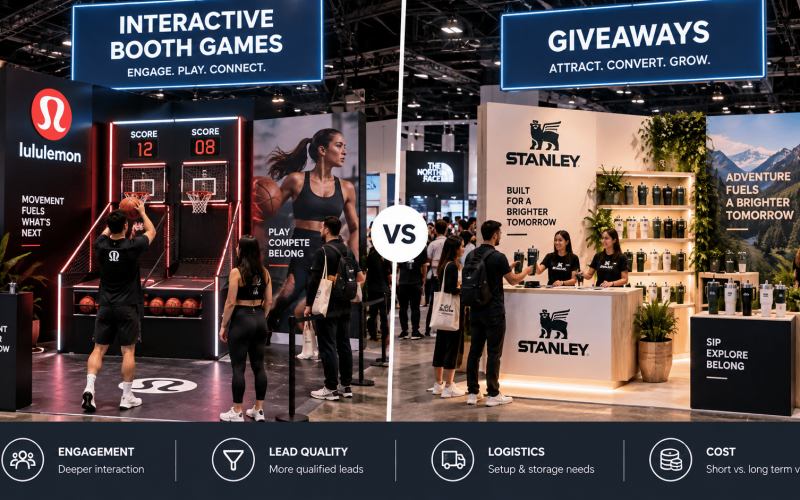
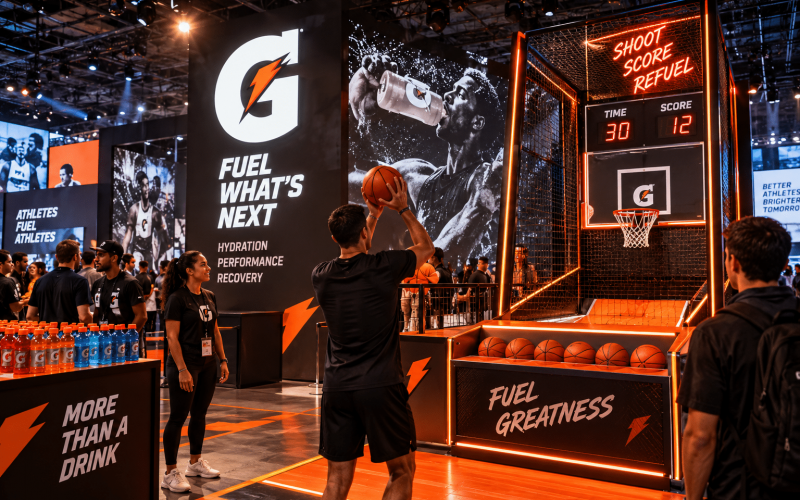
Reaction-button games, light-up challenges, and quick head-to-head contests create energy without requiring a long explanation. They are especially useful in busy exhibit halls, where movement and friendly competition make a booth visible from across the aisle. A challenge lasting 15 to 30 seconds gives participants a reason to stop while keeping the queue moving.
For lead generation, the design should include a meaningful choice before play. Players might select their industry, choose a campaign theme, or answer one qualifying question on a connected registration screen. The post-game moment is equally important. Display a score, invite a photo, and give staff a specific reason to engage high scorers or participants who match target-account criteria.
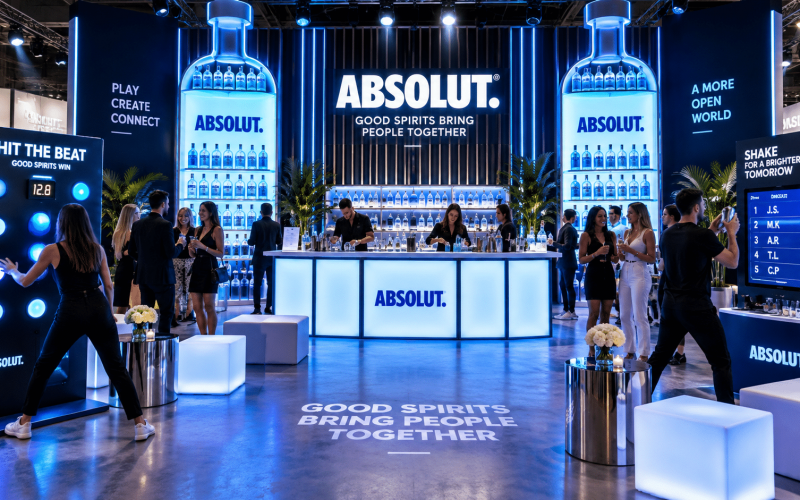
Physical interaction matters here. A custom-fabricated game housing, branded buttons, integrated lighting, and a clean monitor surround can make a simple mechanic feel premium and campaign-specific. That is often more memorable than a standard arcade rental with a logo panel added at the last minute.
4. Claw machines and skill-based prize games
A branded claw machine attracts attention because the outcome feels uncertain but achievable. It is a strong choice for product launches, retail-facing campaigns, and events where prizes can reinforce the brand story. The machine can hold product samples, branded merchandise, event-only offers, or tokens that lead to a larger redemption experience.
The trade-off is that a claw machine can become a prize destination rather than a lead-generation tool. Avoid this by tying gameplay to a simple registration flow and limiting premium prizes to attendees who complete the intended action, such as booking a consultation or viewing a product demonstration. Consider the prize mix carefully. Valuable enough to motivate, but not so expensive that it attracts people who have no connection to the category.
Custom wrapping alone is not always enough. A fully integrated cabinet, branded prize capsules, coordinated signage, and clear staff positioning turn the game into part of the booth environment.
5. Digital quizzes with a personalized result
A short assessment can be one of the most effective games for B2B lead capture because the result creates a logical reason to exchange contact information. A visitor answers a few questions and receives a score, recommendation, or benchmark relevant to their role. An event technology company might offer a “How ready is your event data strategy?” assessment. A workplace brand might deliver a personalized productivity profile.
The results must provide actual value. If the quiz is only a form with playful graphics, attendees will recognize the transaction and abandon it. Keep questions limited, make the output specific, and let booth staff use the result to guide a conversation. The captured data should route into the sales or marketing workflow with clear consent and an agreed follow-up plan.
Digital assessments are less visually dramatic than reaction games, so pair them with a strong screen presentation, a branded counter, or a physical visual element that makes the interaction visible from the aisle.
6. Collaborative games for team engagement
Some booth games are designed for more than one person. A collaborative puzzle, rapid-build challenge, or multi-player digital game can bring colleagues into the booth together. This is useful when buying decisions involve several stakeholders or when a brand wants to demonstrate themes such as teamwork, speed, design, or problem-solving.
Collaboration also gives staff more time to observe and engage. Instead of one attendee tapping through a form, multiple participants discuss choices and reveal their working dynamic. That can create a better opening for a consultative conversation, particularly at industry conferences with account-based marketing goals.
These games require more space and active facilitation. They are a poor fit for a narrow 10-by-10 booth with limited staffing, but they can become a focal point in an island exhibit, lounge, or sponsored activation area.
7. Social-first photo and challenge moments
Photo challenges, branded photo booths, and user-generated-content games can extend an event beyond the show floor. Attendees complete a prompt, pose with a physical installation, or compete to create the most inventive content around a campaign theme. For brands selling visual, lifestyle, hospitality, or consumer products, this can generate valuable reach alongside lead capture.
Do not assume social activity equals sales opportunity. Build an opt-in process that separates content permission from marketing consent, and give participants a clear reason to share useful contact details. A photo moment works best when the physical set is distinctive, well lit, and directly connected to the campaign rather than relying on a generic backdrop.
Design the Lead Path Before Fabricating the Game
The game mechanic should follow the lead strategy, not the other way around. Start by defining what counts as a qualified lead and what the booth team needs to learn. Then determine the least intrusive moment to ask for that information. For a high-volume activation, that may be a two-field entry form before play. For enterprise sales, it may be a staff-led conversation after a score or assessment result.
Plan the physical flow as carefully as the game. Registration should not block the aisle. Spectators need a clear view of the action. Prize redemption should be placed where staff can continue the conversation without holding up the next player. Power, screens, storage, sanitation, accessibility, and line management all affect whether a promising concept operates well on show day.
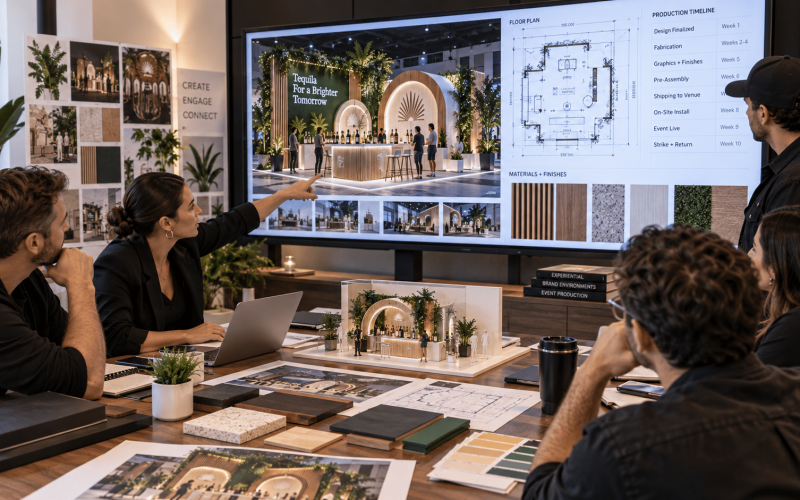
A custom fabrication partner can help resolve those practical requirements early, from the footprint and sightlines to integrated technology and replaceable game components. For nationwide brand activations and fabricated trade show environments, Portadecor builds physical game elements that support the campaign rather than compete with it.
Choose a booth game that gives the right attendee a reason to stop, a relevant reason to identify themselves, and a clear next step after the applause or prize. That is where event engagement becomes a sales opportunity.