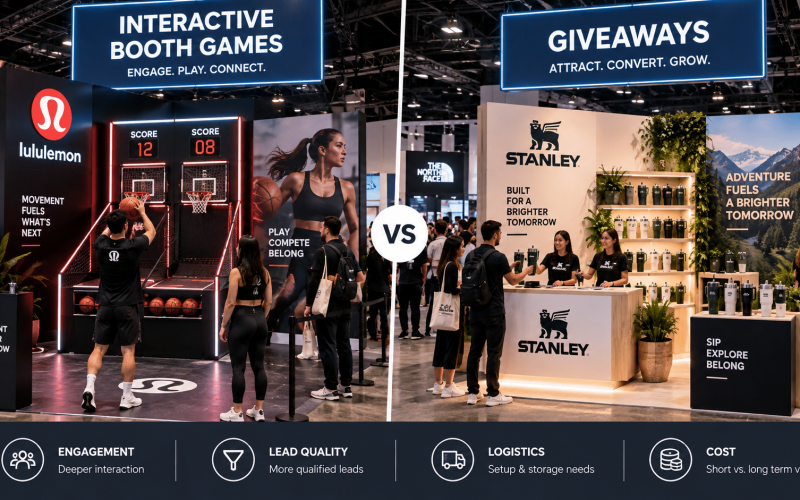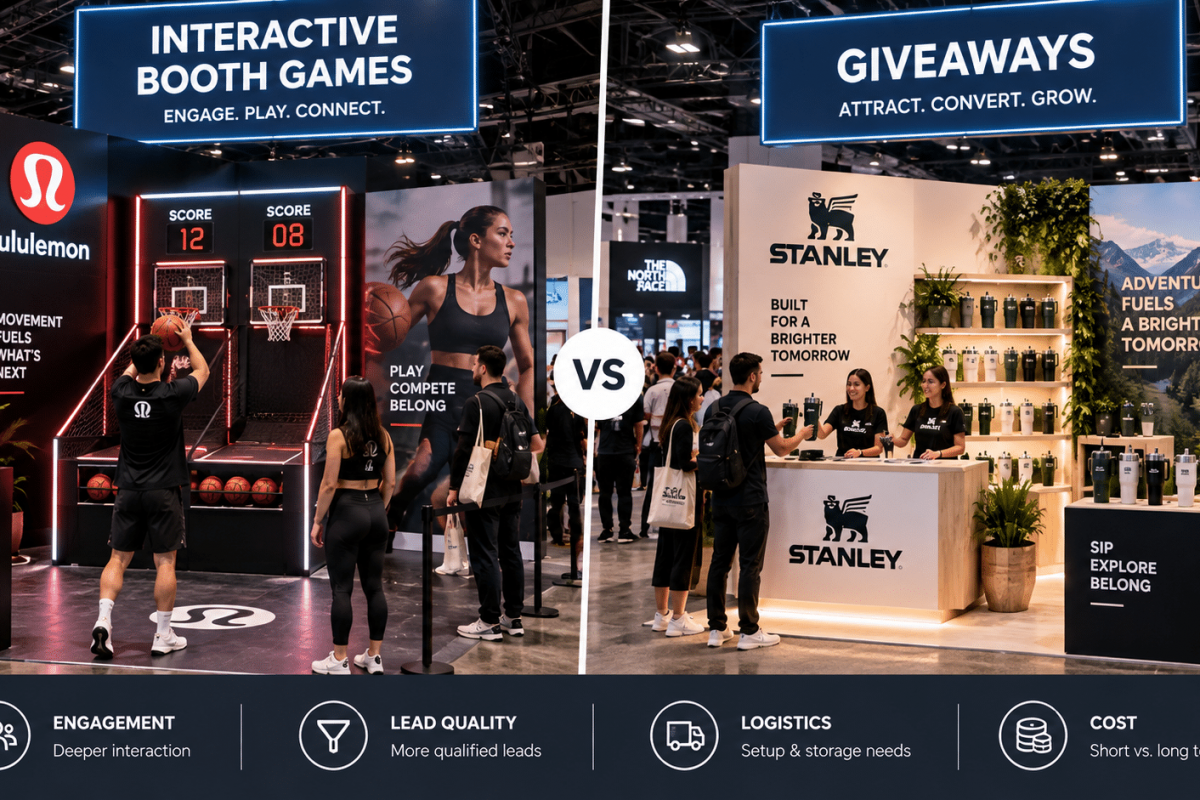
A tote bag can get someone to stop. A well-built game can get them to stay, participate, share a moment with colleagues, and give your team a real opening to talk. That is the practical difference at the center of interactive booth games vs giveaways. Both can earn attention at a trade show or brand activation, but they produce very different kinds of engagement.
The right choice is not about declaring games better than premiums in every setting. It depends on your campaign objective, floor space, staffing plan, audience volume, budget, and what needs to happen after the event. For many brands, the strongest answer is a deliberate combination: an interactive experience that creates the conversation, supported by a giveaway people are glad to take with them.
What Each Approach Is Designed to Do
Giveaways are distribution tools. They extend brand visibility beyond the booth, offer an immediate incentive to approach, and can support a campaign message when the item is useful and well branded. Pens, drinkware, tote bags, stickers, chargers, product samples, and premium gifts all have a place when the goal is reach, appreciation, or a simple call to action.
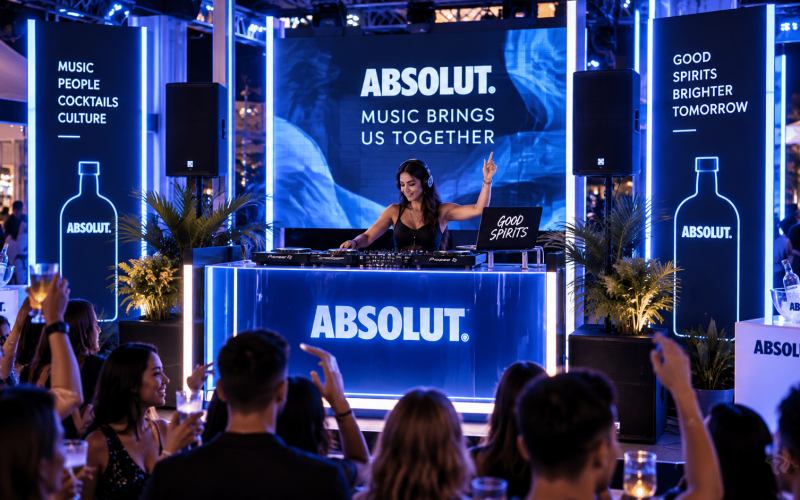
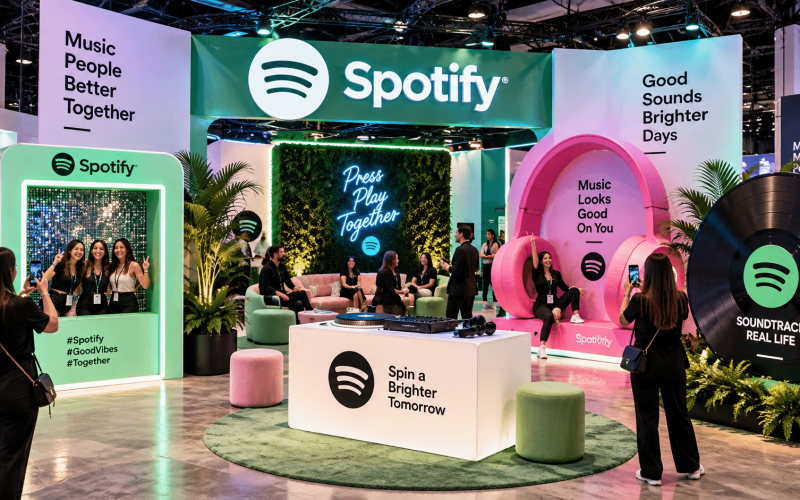
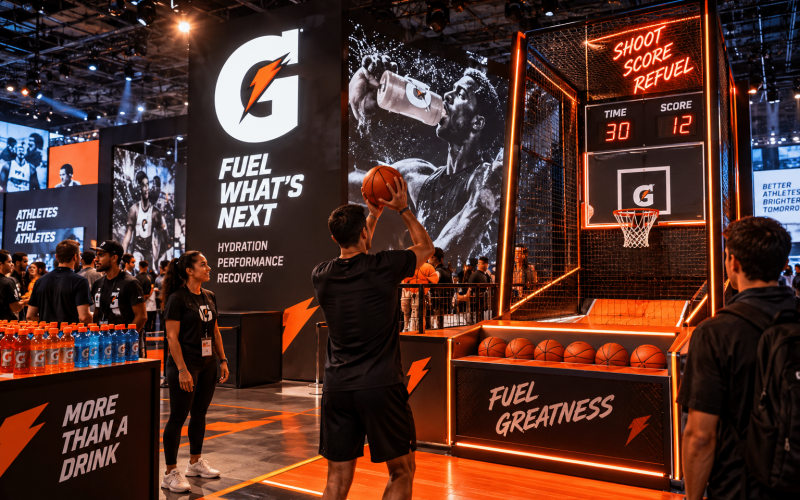
Interactive booth games are participation tools. They create a reason for attendees to spend time in the environment, often turning a passive walk-by into a structured brand interaction. A custom prize wheel, claw machine, arcade-style game, reaction challenge, trivia wall, or digital leaderboard can build energy on the show floor while giving staff a natural way to introduce a product story.
The distinction matters because foot traffic is not the same as engagement. A crowded booth collecting hands is not necessarily creating qualified conversations. Conversely, a game that takes too long can create a line that looks impressive but limits the number of people your team can reach. The experience needs to be designed around the business outcome, not just the visual idea.
Interactive Booth Games vs Giveaways: The Core Trade-Off
Giveaways usually win on speed and scale. A staff member can distribute hundreds of items in an hour, and the cost per item is easier to forecast. They are especially effective for high-traffic shows where attendees expect to move quickly, or when a product sample itself is the reason to visit.
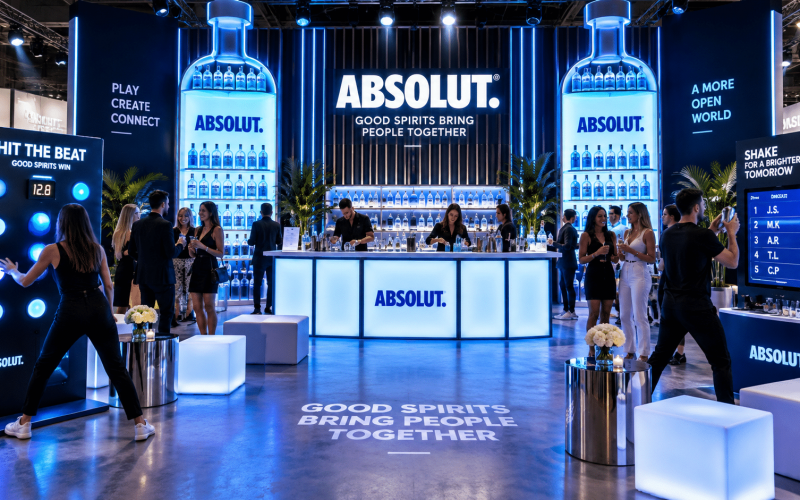
Games typically win on dwell time and memorability. A participant who plays for one or two minutes has more opportunity to hear a message, answer a qualifying question, see a product demonstration, or receive a more relevant follow-up. The physical experience also creates a stronger visual signal across the aisle. Movement, cheering, illuminated game elements, and visible prizes can pull people toward a booth before they know what the brand offers.
That advantage comes with operational demands. A game requires enough footprint, clear queue management, staff who can facilitate it, a reset plan between players, and fabrication that can handle repeated use. If the activity is complicated, poorly explained, or disconnected from the product, it becomes entertainment without commercial value.
A giveaway has risks of its own. Generic items disappear into crowded tote bags. Cheap products can undermine a premium brand position, while expensive products may be handed to attendees with no buying influence. Without a qualification mechanic, the brand may be paying for impressions with little ability to measure who received them or what happened next.
Start With the Outcome, Not the Object
Before choosing an activation element, define the event’s primary job. Most programs have several goals, but one should lead the design decision.
If the priority is brand awareness, a visually distinctive game installation can work as a beacon. A large custom game, branded furniture, and an active crowd create content-worthy moments that extend the activation beyond the immediate participant. Add a simple branded takeaway so people leave with a reminder of the experience.
If the priority is lead generation, build the game around a deliberate exchange. Entry can follow a short product question, a badge scan, a scheduled demo, or a preference selection that helps the sales team segment follow-up. The objective is not to make registration burdensome. It is to connect participation to useful information and a clear next step.
If the priority is product education, the interaction should reinforce a product benefit. A cybersecurity company might use a timed decision challenge. A beverage brand might create a flavor-matching game. A software company might use a quick quiz that illustrates a common operational problem. The game should make the message easier to remember, not compete with it.
If the priority is customer appreciation, a premium giveaway may be the better investment. A hosted client event, executive meeting, or smaller hospitality environment does not always need a high-volume game. In that setting, thoughtful materials, comfortable event furniture, and a personalized gift can better match the audience.
Design the Game Around Throughput
The most attractive booth game can become a bottleneck if it is not designed for the expected crowd. This is where execution planning has a direct effect on performance.
Calculate how long one complete interaction takes, including instructions, play time, prize selection, lead capture, photography, and reset. A two-minute game may sound efficient, but it can serve only 30 people per hour at one station before accounting for interruptions. Multiple play positions, a shorter format, or a separate prize redemption area can protect throughput during peak periods.
The experience should be understandable from several feet away. Attendees should be able to see what the game is, what they might win, and where to enter without relying on a staff explanation. Clear rules, accessible controls, and an obvious finish point reduce friction. For a custom build, this needs to be considered before fabrication, along with power, storage, transport, assembly, maintenance, and ADA-conscious access.
Prize strategy also changes behavior. Small instant-win items keep the line moving. Larger prizes can create anticipation and support lead capture, but they may require a drawing structure, terms, and post-show fulfillment. Many activations use both: a quick participation reward and a higher-value prize tied to a more qualified action.
Make Giveaways Earn Their Place
A giveaway does not need to be expensive to be effective. It needs to fit the attendee, the event context, and the brand promise. A useful item with a clean, intentional design is often more valuable than a novelty item that gets discarded before the attendee reaches the hotel.
Consider when and where the item will be used. At a conference, a quality tote, phone accessory, notebook, or refillable bottle can offer practical value. At an outdoor brand activation, weather-appropriate or on-site utility items may make more sense. For product launches, a sample or product-adjacent item can reinforce the reason the audience came in the first place.
Distribution rules matter. If everyone receives the same item at the booth entrance, the giveaway may attract traffic but not conversations. If it is held until after a demo, game, survey, or meeting, it can support a more intentional engagement sequence. The right approach depends on how much friction your audience will accept and how much staff capacity is available.
Avoid treating a logo as the entire strategy. A branded item should point back to a message, a visual system, or an experience people can recall. Consistent colors, materials, copy, and display elements make the takeaway feel like part of the activation rather than an afterthought.
When a Hybrid Model Delivers More Value
For most trade show booths, games and giveaways are not competing line items. They work best as parts of a single attendee journey. The game creates the draw. Staff use the moment to qualify interest or demonstrate value. The giveaway becomes the reward, reminder, or reason to continue the conversation after the event.
For example, a custom prize wheel can be positioned at the booth edge to attract attention. Participants answer a brief brand question or complete a product interaction before spinning. Instant prizes keep the experience light, while a premium drawing reward encourages opt-in. The physical build, prize display, signage, lead-capture point, and staff flow should all operate as one environment.
This model also helps control cost. Instead of ordering a high-value item for every passerby, brands can reserve better rewards for participants who complete the intended action. Lower-cost items can maintain broad visibility, while the game provides the reason to engage rather than simply collect.
Budget Beyond the Unit Price
A giveaway budget is often straightforward: item cost, branding, freight, storage, and distribution. But the lowest unit cost does not always produce the lowest effective cost. If most items are ignored or reach unqualified recipients, the program may have little measurable value.
A game investment includes creative development, custom fabrication or rental, graphics, freight, installation, staffing, power, and contingency planning. It can appear more expensive upfront because it is a physical event asset rather than a case of merchandise. Yet a well-designed game may be used across a tour, adapted for multiple markets, or rented as part of a flexible event program.
For nationwide activations, experienced fabrication planning is particularly useful when the same branded experience must arrive consistently across venues. Portadecor builds custom event products and interactive elements with the practical requirements of live deployment in mind, from branded presentation to durable construction and event-ready setup.
Measure What Happened, Not Just What Left the Booth
The useful metrics differ by format. For giveaways, track distribution volume, cost per item, redemption rates when applicable, and any follow-up action connected to the item. For games, measure participants, average dwell time, lead-capture rate, qualified conversations, demos scheduled, social content created, and staff observations about audience response.
Compare those numbers against the activation’s actual goal. A game may produce fewer total contacts than a simple giveaway table but generate substantially more qualified leads. A giveaway may not create long conversations but could be the right decision for a large sponsorship footprint where brand reach is the assignment.
Build the experience your team can operate well, not the one that looks most elaborate in a concept deck. When the interaction, fabrication, staffing, and takeaway all support the same objective, the booth has a better chance of earning attention that lasts beyond the show floor.