A branded lounge that looks sharp in a rendering but wobbles on a show floor is not an experience. Neither is a photo moment that cannot handle a full day of guest traffic, or an interactive game that arrives without a workable reset plan. Event teams need physical environments that perform as well as they photograph. That is where the answer to what is experiential fabrication becomes practical.
What Is Experiential Fabrication?
Experiential fabrication is the design, engineering, and production of custom physical elements used in brand activations, trade show booths, pop-ups, product launches, and live events. It turns a creative concept into a real-world environment people can enter, touch, use, photograph, and remember.
The work may include branded furniture, dimensional logos, display fixtures, product showcases, modular walls, interactive games, photo moments, sampling stations, bars, stages, and custom structures. Unlike standard event décor, these assets are developed around a specific brand objective, venue footprint, audience behavior, and operating plan.
A fabrication partner is not simply making an object. The partner is solving for appearance, structural integrity, guest flow, setup, breakdown, shipping, safety, and repeat use. For an activation to work, every one of those requirements has to support the creative idea rather than compromise it.
Experiential Fabrication Turns Concepts Into Usable Environments
Creative teams often begin with a campaign idea: introduce a product, create shareable content, drive sampling, collect leads, or give attendees a reason to spend more time at the brand footprint. Experiential fabrication is the production discipline that makes that idea tangible.
For example, a beverage brand may want a game that communicates product benefits without feeling like a sales display. The fabricated result could be a custom branded game unit, complete with integrated storage, durable play surfaces, signage, lighting, and a reset process for staff. A beauty brand may need an elevated product discovery area. That could require custom display plinths, tester stations, mirrors, seating, and dimensional brand elements designed to work together in a limited footprint.
The finished environment should feel intentional from every viewing angle. It must also work for the people operating it. Staff need room to move, products need accessible storage, cables need a path, and high-touch surfaces need materials that hold up under continuous use.
It Is More Than a Custom Build
Custom fabrication is a core part of the process, but experiential fabrication has a narrower purpose: producing for live audience interaction. That distinction changes the requirements.
A retail fixture may be designed for a long installation in a controlled store. An event asset may need to ship across the country, load through a service entrance, assemble within a short install window, withstand thousands of interactions, and break down efficiently at the end of the show. A visually impressive piece that ignores those conditions can create delays, extra labor, or a poor guest experience.
This is why experienced event fabricators ask operational questions early. What is the venue access? Is the asset used once or across a tour? Will it be outdoors? Does it need power? How many guests will interact with it each hour? The answers affect materials, construction methods, finishes, packaging, and budget.
What Does Experiential Fabrication Include?
The scope depends on the campaign, but most projects combine creative interpretation with technical production. A fabrication team reviews the concept, develops buildable details, selects materials, produces the components, and prepares them for installation or delivery.
Common experiential fabrication work includes custom trade show booths, branded event furniture, display systems, immersive scenic environments, product demonstration stations, branded bars, interactive game elements, photo activations, and large-format dimensional signage. It can also include practical additions that guests may not notice but operators rely on, such as lockable storage, weighted bases, cable management, replaceable graphics, and transport-ready crating.
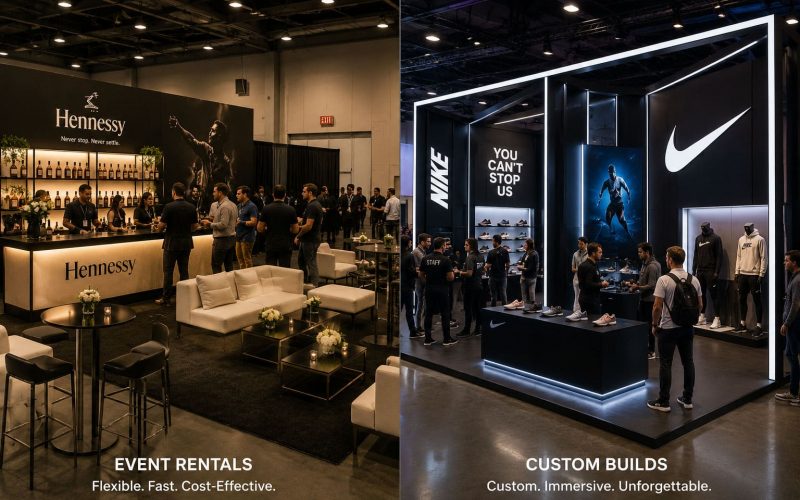
Some assets are fully custom because the campaign requires a distinct shape, function, or visual identity. Others use a smarter hybrid approach: rentable furniture, counters, or structural components paired with custom branded elements. This can reduce production time and cost while preserving a tailored appearance.
Why Fabrication Quality Affects Event Results
For brand marketers and agencies, fabrication quality is not just a production concern. It affects campaign performance.
A well-built activation helps create a clear first impression, supports engagement, and gives guests a reason to participate. It also protects brand consistency. Colors, materials, logo treatment, proportions, and finish quality all influence whether an environment feels premium, approachable, technical, playful, or credible.
Quality also shows up in less visible ways. Doors close correctly. Counters remain stable. Graphics align. Seating is comfortable. Interactive components reset quickly. The staff can focus on attendees instead of troubleshooting the build. Those details directly affect throughput, dwell time, content capture, and the overall perception of the brand.
There is a budget consideration, of course. Not every campaign needs museum-grade materials or a fully bespoke environment. A one-day promotional event may call for efficient, lightweight components, while a multi-city tour needs more durable finishes and modular construction. The right answer depends on campaign duration, transport needs, audience volume, venue conditions, and whether the assets will be reused.
The Experiential Fabrication Process
Strong projects begin with a production-minded review before materials are ordered. The goal is to identify what the concept must accomplish and how it will operate in the field.
First, the team defines the experience: the footprint, audience interaction, brand requirements, venue limitations, timeline, and budget range. From there, the concept is translated into production details. This may involve shop drawings, engineering, finish samples, material recommendations, and revisions that make the design more durable or efficient without losing its intended impact.
Fabrication follows once the build plan is approved. Depending on the project, this can involve woodwork, metalwork, CNC cutting, painting, printing, upholstery, acrylic work, electrical integration, and graphics application. Quality checks throughout production help catch alignment, finish, and functionality issues before the asset reaches the event site.
The final phase is event readiness. Components are labeled, packed, and prepared for shipping or install. For larger environments, installation planning matters as much as the build itself. A design that looks simple can require a precise sequence of assembly, tools, crew coordination, and venue compliance.
At Portadecor, this fabrication-first approach is built around the realities of brand activations and trade show environments, where the finished asset has to work under live event conditions.
How to Plan a Fabrication Project More Effectively
The best way to protect a project is to bring fabrication into the conversation before the design is locked. Early production input can prevent a concept from relying on unsupported spans, impractical finishes, inaccessible storage, or components that are difficult to transport.
Share the event brief, renderings, brand standards, venue information, budget parameters, and timeline as early as possible. It also helps to identify nonnegotiables. Is there a signature architectural shape? Does a product need to be displayed at a specific height? Does the experience depend on a particular interaction? A fabricator can then focus the budget on the elements that matter most.
Be clear about reuse as well. If the environment will travel to multiple markets, ask for modular components, replaceable graphics, durable surfaces, and efficient packing. If it is a single event, a lighter and more cost-conscious build may be appropriate. Reuse can improve value, but only when storage, logistics, and future adaptation are part of the plan.
Choosing an Experiential Fabrication Partner
A capable partner should understand both the creative ambition and the execution pressure behind live events. Look for fabrication expertise, familiarity with event timelines, clear production communication, and a process for reviewing practical concerns before they become onsite problems.
Ask how the team approaches materials, shipping, installation, and durability. Review whether they can provide custom-built assets alongside rentable event components when that combination makes sense. Most importantly, look for a partner that treats the build as part of the audience experience, not a separate back-end task.
The strongest experiential environments do not ask guests to admire the construction. They make it easy for guests to engage with the brand. When fabrication is planned with that outcome in mind, the physical space becomes a working part of the campaign, not just its backdrop.