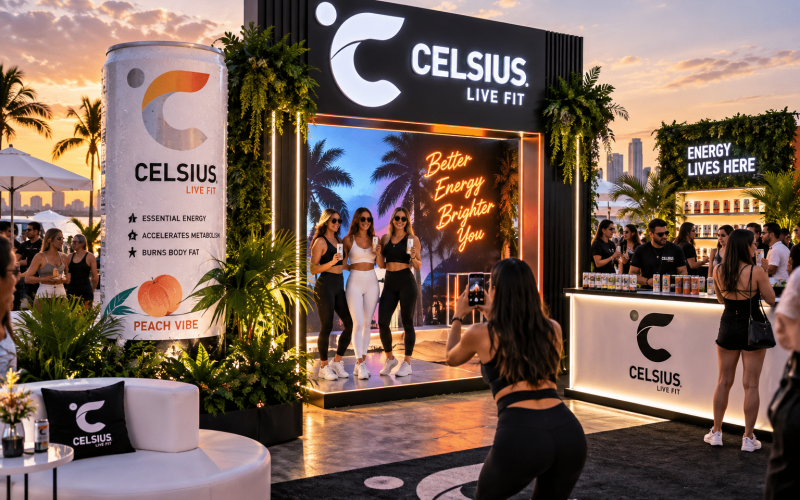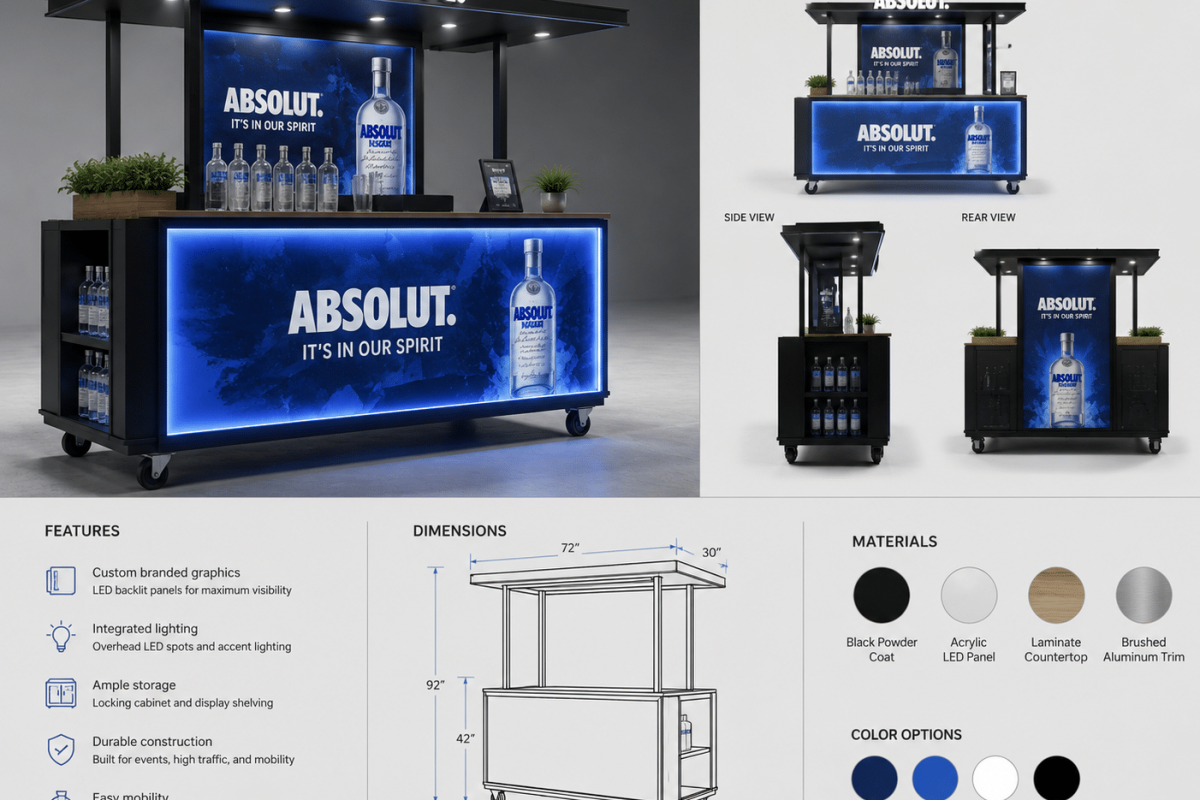
A sampling cart that looks good in a rendering but slows down service on show day is a liability. In experiential marketing, custom sampling cart fabrication has to do more than match brand guidelines. It needs to support traffic flow, product handling, storage, sanitation, transport, and fast setup without losing visual impact.
That is where many projects succeed or fail. A cart is often treated like a small scenic element, when in practice it is a working event asset. If the build does not reflect the realities of product sampling, staffing, venue rules, and repeated deployment, the cart becomes harder to use every time it leaves the warehouse.
What custom sampling cart fabrication needs to solve
For brand activations and trade show environments, a sampling cart usually has two jobs at once. It needs to attract attention from a distance and support efficient interaction up close. Those goals are related, but they are not identical.
A visually strong cart might still be difficult to stock, too heavy to move, or poorly laid out for high-volume service. On the other hand, a highly functional cart can underperform if it does not feel branded, intentional, and camera-ready. The right fabrication approach accounts for both. That means evaluating not just shape and graphics, but also use case, staffing pattern, venue type, and event cadence.
A beverage sample cart at a food festival will have different demands than a skincare testing cart in a retail pop-up. One may require cold storage access, waste handling, and fast replenishment. The other may need product display tiers, tester control, hidden storage, and a cleaner consultation-oriented layout. The fabrication process should start with those operating realities, not with finish selections alone.
Design decisions that affect event performance
The strongest custom sampling cart fabrication projects begin with a practical brief. Before production starts, the team should know what is being sampled, how many staff members will use the cart, how the cart will travel, and what kind of audience interaction is expected.
Footprint and mobility
Mobility is not just about wheels. It is about total maneuverability from shop floor to loading dock to freight carrier to venue entrance to final placement. Oversized carts can create unnecessary cost and access problems, especially in convention centers, hotel ballrooms, and urban pop-up spaces where elevators, door clearances, and loading windows are real constraints.
Caster choice matters, but so does weight distribution. A cart can technically roll and still be frustrating to move if it is top-heavy or awkward to steer. In many cases, the best solution is not the largest cart possible, but the most efficient one for the activation footprint and staffing model.
Storage and service flow
Sampling volume drives storage needs, but the type of product matters just as much. Individually packaged items, refrigerated beverages, cosmetics, and fresh food all require different internal configurations. Drawers, shelves, access panels, trash integration, and concealed stock zones should support how staff actually work during a live event.
This is where fabrication experience is valuable. A beautiful exterior is easy to specify. A cart that allows a brand ambassador to restock without breaking the guest interaction rhythm takes more thought. When service flow is well planned, the cart feels polished because the activation runs smoothly.
Brand expression without overbuilding
Branding should be integrated into the cart structure, not treated as an afterthought. That can include dimensional logos, custom shapes, color-matched finishes, product display features, and signage areas built into the form. But there is a trade-off. The more highly specific the structure becomes, the more it may limit reuse across multiple campaigns.
For some programs, that is the right call. A hero launch asset may need a fully customized silhouette and a one-off visual statement. For roadshows or recurring sampling programs, modular branding zones can be a better investment. The goal is to decide early whether the cart is being built for a single moment, a seasonal campaign, or a repeatable platform.
Materials matter more than most teams expect
In custom sampling cart fabrication, material selection affects durability, appearance, freight cost, and serviceability. A cart that will appear at one controlled indoor event has a different build profile than one that will be shipped nationwide for repeated activations.
Wood-based fabrication can deliver a premium look and strong branding flexibility, but weight has to be managed carefully. Metal components can improve structural integrity and long-term durability, especially for high-use rolling assemblies or hardware zones. Acrylic, laminate, powder-coated surfaces, and printed elements each bring different benefits depending on the visual standard and wear expectations.
There is no universal best material. It depends on event environment, expected lifespan, and budget. A lower-cost finish may look excellent on day one but require more maintenance over time. A more durable construction may increase upfront cost while reducing replacement and repair later. For event marketers managing multiple stops, that trade-off is worth evaluating early instead of after the first damaged return.
Fabrication details that protect the guest experience
A sampling cart sits at the point of interaction. Guests lean on it, photograph it, inspect it at close range, and judge the professionalism of the brand through it. That makes finish quality and small construction details more important than they might seem in early planning.
Edges should feel intentional and safe. Access doors should open cleanly and close securely. Hardware should hold up under repeated use. Graphic areas should be aligned to the structure rather than forced onto it. If lighting, power integration, or refrigerated components are involved, those systems need to be planned into the fabrication from the start.
Sanitation is another major consideration. For food and beverage sampling, easy-clean surfaces and practical waste management are not optional. Even in non-consumable categories, the cart should support a clean and organized presentation. The audience may not notice every fabrication detail consciously, but they do notice when the asset feels unstable, cluttered, or improvised.
Why prototyping and revisions can save the project
Sampling carts often look simple because they are compact. In reality, compact builds leave less room for error. Small dimensional changes can affect usability, sightlines, and storage capacity quickly.
That is why a review process matters. Shop drawings, finish approvals, and production checkpoints reduce the chance of discovering issues once the cart arrives onsite. For more complex concepts, prototyping key features or reviewing physical samples can prevent expensive rebuilds. This is especially relevant when the cart includes moving components, refrigeration, branded toppers, or detachable elements for transport.
Fast timelines are common in activations, but speed should not eliminate verification. A cart that misses the event objective by a few inches, a poor access angle, or an unstable top feature can create operational friction all day long.
Custom sampling cart fabrication for repeat programs
Not every sampling cart is a one-off. Many brands and agencies need a system they can deploy across multiple cities, venue types, and campaign phases. In that case, custom sampling cart fabrication should emphasize repeatability as much as appearance.
That may mean designing for easier packing, replaceable graphic panels, or removable branded elements that adapt to different sponsors, flavors, or product lines. It can also mean simplifying certain features to improve speed of setup and reduce damage risk in transit. A cart used ten times has a different value equation than one built for a single flagship event.
For nationwide activations, this operational thinking becomes even more important. The cart has to survive shipping, labor variability, and changing venue conditions while still presenting as a premium branded asset. That is where fabrication discipline matters. Good design gets attention. Good build strategy keeps the program running.
Choosing the right fabrication partner
A vendor that understands general millwork is not always the same as a partner that understands event use. Sampling carts for experiential programs live in a different context than showroom fixtures or retail furniture. They need to be branded, durable, activation-ready, and realistic for load-in and live staffing.
The best partner will ask practical questions early. What product is being served? How many interactions per hour are expected? Does the cart need power? Does it need to break down? Will it travel by freight? Is it intended for indoor use only? How often will it be redeployed? Those questions shape the fabrication strategy and usually improve the final result.
Portadecor approaches custom fabrication from that event-focused perspective because the asset is only successful when it works in the field, not just in the shop. For agencies and brand teams, that reduces the gap between concept approval and event execution.
Custom sampling cart fabrication is most effective when it is treated as part of the activation system, not just a branded object. When the cart is built around real service needs, transport realities, and brand presentation standards, it does more than hold product. It helps the experience move the way it should.