A 10×20 footprint can look efficient on paper and still underperform on the show floor. That usually happens when the exhibit format does not match the program. In the modular booths vs custom exhibits decision, the real question is not which option is better in general. It is which one fits your timeline, budget, reuse plan, brand standards, and event goals.
For brand marketers, trade show managers, and agency teams, that choice affects more than aesthetics. It influences install time, shipping, storage, labor, durability, audience flow, and how much control you have over the final brand experience. If the exhibit needs to support product storytelling, demos, lead capture, and visual impact at the same time, the format matters early.
What modular booths actually do well
Modular booths are built from pre-engineered systems and components that can be reconfigured across different layouts. That makes them attractive for teams running multiple events, rotating through booth sizes, or trying to keep production and logistics more predictable.
The biggest advantage is flexibility within a defined system. A modular exhibit can often be resized from one show to the next, refreshed with new graphics, and packed more efficiently than a one-off build. If your calendar includes regional trade shows, smaller conference footprints, or recurring events where speed matters, modular can be a practical fit.
Budget control is another reason buyers choose modular. Not because modular always means cheap, but because it usually reduces custom engineering, simplifies fabrication, and creates more repeatable deployment. For programs with multiple stops, that repeatability can matter as much as the initial price.
There is also less risk in certain timelines. When a team is working against a compressed event schedule, modular solutions can shorten decision-making and production cycles. You are not starting from a blank sheet every time.
Where custom exhibits pull ahead
Custom exhibits are built around the brand, the campaign, and the physical experience you want attendees to have. That means fewer constraints and more control over shape, materials, product integration, lighting, storage, traffic flow, and experiential elements.
If your exhibit needs to feel specific to the brand rather than adapted from a system, custom fabrication usually delivers a stronger result. This is especially true for launches, anchor events, flagship trade shows, and environments where the booth itself is part of the marketing message.
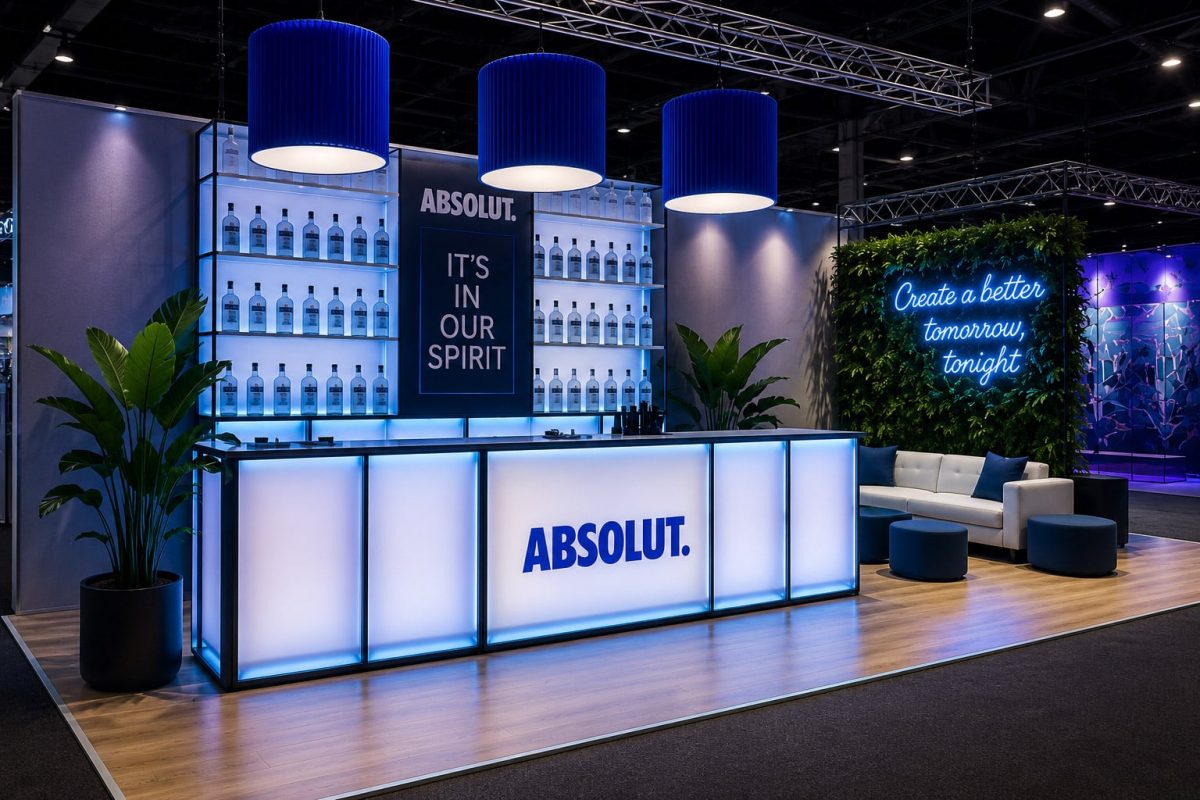
A custom exhibit also gives you more freedom to solve real functional needs. Maybe you need concealed storage for product inventory, an elevated demo platform, integrated hospitality counters, custom shelving, branded gaming elements, or architectural features that support a campaign theme. Those details are often what separate a booth that gets noticed from one that gets passed.
That does not mean custom is automatically the right answer for every event. It means custom becomes more valuable as brand expectations, experience goals, and environmental complexity increase.
Modular booths vs custom exhibits: the main trade-offs
The modular booths vs custom exhibits conversation usually comes down to four variables: cost, speed, flexibility, and impact. The problem is that each one changes depending on the event program.
On cost, modular often wins upfront. But if a custom environment is designed for reuse across a long campaign, the numbers can shift. A well-built custom asset can justify itself when the same environment supports multiple shows, pop-ups, and activations with only minor updates.
On speed, modular usually has the edge. Systems are easier to plan around, and there are fewer fabrication unknowns. Custom exhibits require more coordination across design, engineering, production, graphics, and install planning. The result can be stronger, but the process is more involved.
On flexibility, modular is flexible in one sense and restrictive in another. It can adapt within a system, but it is still a system. Custom exhibits are less plug-and-play, yet they are more flexible from a creative and functional standpoint because they are built around your exact use case.
On impact, custom usually creates more distinction. That matters when the event is highly competitive, your audience expects a premium presentation, or the booth needs to carry a campaign visually. A standard-looking environment can undermine a strong brand, even when the messaging is solid.
When modular booths make the most sense
Modular is often the right choice for event teams managing frequency and scale. If you attend several shows per year with changing footprints, a modular approach can keep execution consistent without rebuilding from scratch each time.
It also works well when the objective is efficient brand presence rather than full immersion. For example, if the booth is primarily supporting meetings, product display, literature distribution, and light demo activity, modular can handle the need without overbuilding the environment.
Agencies and in-house teams also use modular when approvals are still moving. A system-based booth can provide enough structure to keep timelines on track while leaving room to update graphics and selected features as the campaign sharpens.
For some programs, a hybrid strategy is the most practical route. You keep a modular core for structure and add custom branded elements where they matter most. That might include custom counters, product displays, signage features, or interactive components that elevate the space without committing to a fully custom build.
When custom exhibits are worth the investment
Custom exhibits make the most sense when the physical environment needs to do heavy lifting. That includes product launches, large-format trade shows, investor-facing environments, major industry events, and experiential activations where the booth must support brand storytelling and engagement at a higher level.
They are also a better fit when the brand has strict visual standards that modular systems cannot fully support. Material choices, finishes, geometry, and integrated experiences all contribute to perceived quality. If your audience notices details, those details should be intentional.
Custom becomes especially valuable when your team wants to control visitor movement and dwell time. A fabricated environment can be built around interaction zones, demo moments, hospitality areas, storage, and tech integration in a way that feels natural rather than added on.
For nationwide activations, custom fabrication can also support consistency across markets while preserving the distinctive look of the campaign. The asset may be fixed rather than modular, but it can still be designed with transport, install, and repeated deployment in mind.
The operational side buyers should not ignore
Exhibit decisions often get made on renderings, then judged on show-site performance. That is why logistics should be part of the format discussion from the start.
A booth that looks impressive but requires excessive drayage, specialized labor, difficult packing, or frequent repairs can become expensive fast. The opposite is also true. A booth that is easy to ship and install but fails to support traffic flow or brand visibility can cost you opportunities on the floor.
This is where fabrication expertise matters. The right partner does not just ask what you want the booth to look like. They ask how often it will travel, who will install it, what needs to be stored on site, how graphics will be updated, and what kind of attendee interaction the space needs to support.
For teams producing events in New York, New Jersey, Boston, or Connecticut, rental and deployment considerations may influence the decision even more. In dense markets and union-heavy venues, the smartest exhibit is often the one that balances visual ambition with setup practicality.
How to choose without overcomplicating it
Start with the event program, not the exhibit type. If you are solving for repeatability, varying booth sizes, and controlled logistics, modular may be the better fit. If you are solving for brand distinction, experiential engagement, and a highly tailored environment, custom is usually the stronger option.
Then look at lifespan. Is this a one-show need, a seasonal campaign, or a multi-market asset? A booth built for one event should be evaluated differently from one intended to support a year of activations.
It also helps to define what cannot be compromised. For some brands, that is budget discipline. For others, it is visual ownership, interaction design, or premium presentation. Once that priority is clear, the right path usually becomes obvious.
Many of the best programs are not purely modular or purely custom. They combine reusable structure with fabricated brand moments that create impact where it counts. That approach can protect budget while still giving the audience something worth walking into.
The best exhibit format is the one that performs under real event conditions, supports your brand without forcing compromises, and gives your team confidence on show day. If you are choosing between efficiency and expression, the answer is often not either-or. It is how well the build strategy supports the result you actually need.