A branded lounge can look polished and a trade show booth can stop traffic, but neither guarantees that attendees will participate. An interactive game campaign gives people a clear reason to step in, play, compete, and spend more than a passing glance with the brand. When it is designed around a real event objective, the game becomes a working part of the activation rather than a decorative add-on.
For marketers and event producers, the challenge is not simply choosing a familiar game and applying a logo. The experience has to attract attention from the aisle, make sense in seconds, support the campaign message, withstand continuous use, and give the team a practical way to measure results. That requires creative thinking and production planning in equal measure.
Start With the Business Outcome
The strongest game concepts begin with the action the brand wants attendees to take. A new product launch may need product education and sampling. A trade show program may need qualified leads and booked meetings. A retail pop-up may be focused on social content, foot traffic, or repeat visits. The desired outcome should determine the game format, prize structure, staffing plan, and data capture method.
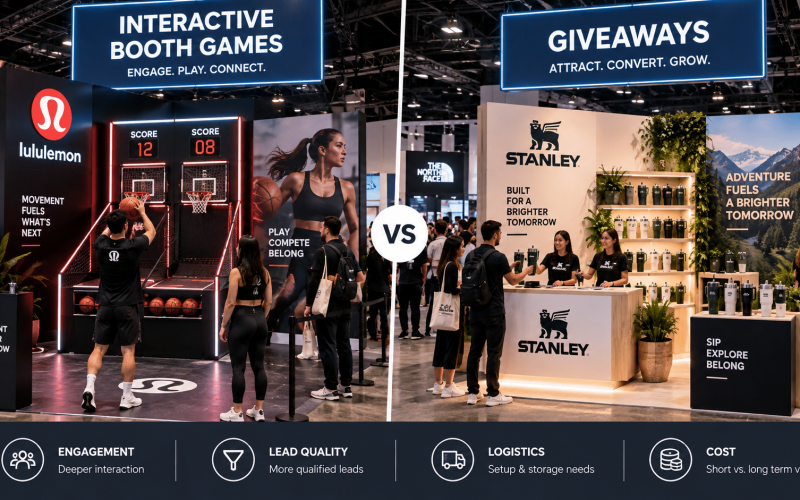
A fast reaction game can create high throughput and visible energy, which is useful on a busy convention floor. A trivia challenge can reinforce product claims when the audience needs more context. A build, race, or team challenge can keep a group in the space longer and create a more social brand moment. None is automatically better. The right choice depends on the event environment and the job the activation needs to do.
Set one primary objective before creative development starts. Trying to maximize education, lead volume, content creation, sales conversion, and dwell time in one small footprint usually produces a confusing participant experience. Secondary benefits are welcome, but the participant should understand the main invitation immediately.
Design the Interactive Game Campaign Around the Attendee
At live events, attention is limited. A person walking past a booth should be able to recognize what is happening and how to join without reading a wall of instructions. The best interactive game campaign designs use a visible action, a clear reward, and a short path to participation.
The first 10 seconds matter. Is there an obvious play surface, oversized physical element, digital display, countdown, or friendly facilitator inviting people in? Does the game look active even when someone is not playing? A game that requires a long explanation may still work for a targeted VIP audience, but it can struggle in a high-volume trade show setting.
Time-to-play deserves equal attention. A 30- to 90-second challenge can move a consistent flow of participants through a small footprint. A three-minute experience may create deeper engagement but needs enough space for a queue, a stronger host, and an honest capacity calculation. If the event expects heavy traffic, build the queue into the experience rather than treating it as an operational problem after doors open.
The brand should be present in the mechanics, not merely printed on the side panels. A beverage brand might turn flavor discovery into a timed matching challenge. A technology company could use a collaborative task that demonstrates speed, precision, or connection. The goal is to make the core action feel related to the brand promise without forcing attendees through a sales pitch.
Build for Visibility, Repetition, and Real-World Use
A game element for an event has to perform under conditions that a presentation mockup does not show. Guests will lean on it, move around it, play repeatedly, and occasionally use it in ways no one predicted. Materials, mounting, edges, cables, controls, and reset processes all affect whether the experience remains polished through the final event hour.
Custom fabrication makes it possible to shape the game around the event rather than settling for an off-the-shelf format. That could mean a branded claw game cabinet, a large-scale tabletop challenge, custom plinko, an illuminated prize wheel, a modular wall game, or a completely original physical mechanic. The fabrication approach should match the expected lifespan. A one-day activation and a multi-city tour do not need the same construction strategy.
Visibility also has practical limits. Oversized pieces draw attention, but they must fit freight constraints, venue loading procedures, ceiling clearances, and the planned booth footprint. Interactive components need accessible power and safe cable management. Digital screens or sensors may require testing time, backup equipment, and a clear recovery plan if connectivity is unreliable.
Portadecor approaches these details as part of the build, combining custom products and event-focused fabrication with the practical requirements of live brand activations. The result should look intentional from the attendee side and remain workable for the production team behind the scenes.
Plan the Reset Before You Finalize the Game
Every play cycle has a reset. A ball returns to a starting point, a screen returns to its welcome state, a prize is replenished, or a staff member records an entry. Small delays compound quickly when traffic builds.
Walk through the full cycle from the participant’s point of view, then from the event staffer’s point of view. Can the next person begin while the previous player receives a prize? Does someone need to manually reposition pieces after each round? Are consumable materials easy to replace? The answers help determine staffing levels and whether the concept can deliver the intended number of plays per hour.
Make Data Capture Earned, Not Forced
Lead capture works best when it has a clear relationship to the participant’s experience. A prize claim, score leaderboard, replay opportunity, personalized result, or post-event content can justify asking for contact information. Asking for a full form before a guest has seen the game often creates friction, especially in a crowded space.
Keep the form aligned with the campaign objective. If the sales team only needs name, company, and business email to follow up on a meeting request, do not add unnecessary fields. If segmentation matters, one well-chosen qualifying question is usually more valuable than a long questionnaire that discourages participation.
The handoff after the event should be planned before the activation opens. Define how leads are tagged, how quickly they enter the marketing or sales workflow, and what follow-up matches the promise made on-site. A message referencing the challenge, score, or prize is more relevant than a generic post-event email.
Treat Prizes as Part of the Experience
Prizes can increase participation, but they should not become the only reason attendees engage. If the reward is too disconnected from the brand, the booth may attract people who want a giveaway but have no interest in the product or service. That may be acceptable for broad awareness, but it is less useful when qualification is the priority.
A tiered reward structure can balance energy and value. Small branded items keep the line moving. Better prizes for high scores, completed challenges, or qualified conversations encourage more meaningful participation. For some B2B campaigns, access to a product demo, a hosted experience, or a scheduled consultation may be more effective than another giveaway item.
Review venue rules and promotion requirements early. Prize games can involve legal, compliance, and age-related considerations that vary by event and location. Clear rules, disclosed odds where applicable, and trained staff protect the attendee experience and reduce last-minute changes.
Measure More Than Foot Traffic
A busy game area looks successful, but activity alone does not explain campaign value. Establish a short scorecard tied to the initial objective. Participation count, completion rate, average dwell time, qualified leads, meeting requests, social posts, and product interactions can each be useful, depending on the program.
Context matters when interpreting results. A lower number of participants may be a strong outcome if the audience was highly targeted and the team booked quality meetings. Conversely, thousands of quick plays may indicate excellent visibility but limited depth. Compare outcomes to the format, event traffic, staffing, and footprint rather than relying on one universal benchmark.
Capture operational observations as well. Note where lines formed, which instructions created questions, how often staff had to reset the game, and whether prizes were claimed as expected. These findings are often the most valuable input for a second event or a touring activation.
Bring Creative and Production Together Early
The most effective game campaigns are not the ones with the most technology or the biggest prize budget. They are the ones where the creative idea, fabrication plan, venue realities, and staffing model support each other from the start.
Before approving a concept, ask whether it can be understood at a glance, built to endure the event schedule, reset quickly, and measured against a defined outcome. If the answer is yes, the game has a real chance to become the reason attendees remember the activation after the show floor has cleared.