A standard display rarely solves a non-standard event problem. If your team needs a booth that fits an unusual footprint, a branded installation that supports interaction, or event furniture that matches a campaign exactly, the real question becomes: what is custom fabrication, and when does it make sense to use it?
What Is Custom Fabrication?
Custom fabrication is the process of designing and building physical products or environments to meet a specific need rather than buying a pre-made item off the shelf. In the event and experiential marketing world, that can mean trade show booths, branded displays, pop-up environments, activation structures, custom event furniture, product showcases, scenic elements, and interactive game components built around a campaign objective.
The key difference is intent. A stock solution is built for broad use. A custom fabricated piece is built for your brand, your footprint, your audience flow, your creative direction, and your operational requirements. It is not just about making something look different. It is about making something work in a specific real-world setting.
For marketers and event producers, that distinction matters. A custom piece can support product education, improve traffic flow, reinforce branding from every angle, hide operational elements, or create a stronger photo moment. Good fabrication does not simply decorate a space. It helps the space perform.
What Does Custom Fabrication Include?
When people ask what custom fabrication includes, they often picture carpentry alone. In practice, it is a broader production process that can involve design development, engineering, material selection, printing, finishing, assembly, and installation planning.
Depending on the project, custom fabrication may include wood, metal, acrylic, laminate, foam, dimensional lettering, vinyl graphics, lighting integration, shelving, storage, interactive components, and structural elements. In event production, those materials are selected not only for appearance, but also for durability, transport, safety, setup speed, and venue compliance.
That is why custom fabrication tends to sit at the intersection of creative and operational planning. The visual concept has to be buildable. The finished piece has to survive freight, install efficiently, and hold up on show site.
Why Brands Use Custom Fabrication
Most event teams do not choose custom fabrication just to have something unique. They choose it because the job requires more than a generic rental or modular system can deliver.
A product launch may need a hero display built around precise dimensions. A trade show booth may need integrated storage and branded counters that fit a specific sales workflow. A pop-up activation may need a game element that can handle repeated public use. An agency may need one environment that fully aligns with campaign creative rather than approximating it with standard components.
Custom fabrication becomes especially valuable when brand consistency is non-negotiable. If the environment is part of the marketing message, the physical build cannot feel like an afterthought. Color, finish, proportion, signage, interaction points, and layout all shape how attendees experience the brand.
There is also a practical reason to go custom. Sometimes fabrication solves constraints that standard products cannot. Tight venue access, unusual dimensions, hidden tech requirements, ADA considerations, reusable modular sections, and specific traffic patterns can all push a project toward a custom build.
The Custom Fabrication Process
The process usually starts with a concept, but concepts alone are not enough. A strong fabrication partner translates creative goals into production-ready plans.
Creative Development and Scope
At the front end, the team defines what is being built, where it will be used, how attendees will interact with it, and what the brand needs it to accomplish. This is where practical questions matter: Is the piece temporary or reusable? Will it travel city to city? Does it need to break down into smaller sections? Does it need to incorporate product shelving, screens, storage, or lighting?
The clearer the scope, the better the outcome. Event projects get expensive when assumptions stay unspoken.
Design Translation
Once scope is defined, design moves from concept to fabrication planning. That means dimensions, materials, finishes, connection points, graphic applications, and structural details are considered before anything is built.
This stage often determines whether a project stays on budget and on schedule. A design that looks great in a rendering may need adjustments once weight, transport, venue rules, and installation labor are factored in.
Fabrication and Finishing
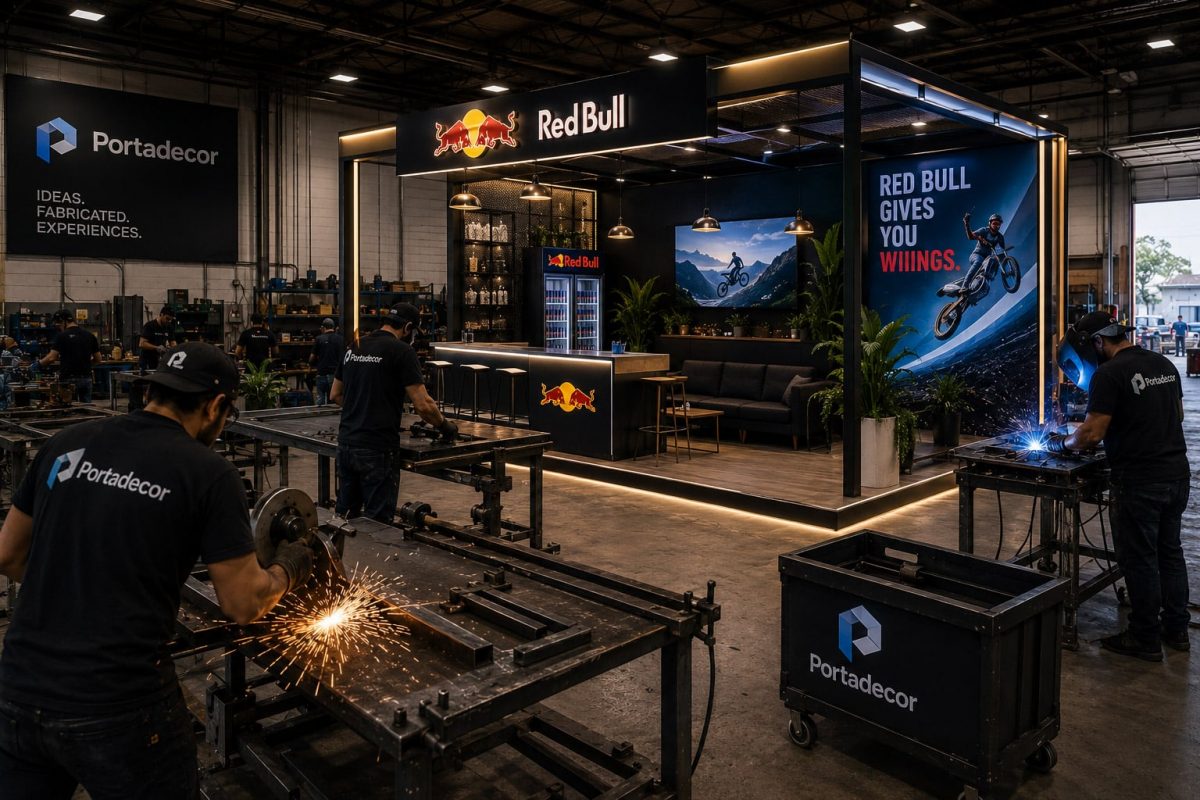
The actual build phase can involve cutting, welding, CNC routing, assembly, painting, laminating, graphic application, and quality control. For event environments, finish quality matters because attendees experience the build up close. Poor seams, chipped edges, unstable surfaces, and mismatched colors are easy to spot on a show floor.
Logistics, Installation, and Use
A fabricated piece is only successful if it works on site. That means packaging, shipping, setup requirements, install sequencing, and dismantle plans need to be part of the process. In experiential marketing, production does not end when the asset leaves the shop.
What Is Custom Fabrication in Trade Shows and Activations?
In trade shows and activations, custom fabrication is the build discipline behind branded physical experiences. It turns booth concepts, scenic ideas, and engagement tools into real structures people can walk through, touch, photograph, and use.
That might include a reception counter tailored to brand aesthetics, a product demo station built around a sales narrative, a backdrop designed for social sharing, or an interactive game unit engineered for repeated attendee participation. In this context, fabrication is not separate from marketing. It is part of how the campaign shows up in the room.
This is one reason event-focused fabrication differs from general manufacturing. The build has to serve both presentation and performance. It has to look polished, but it also has to install on time, function safely, and support engagement under live event conditions.
Custom Fabrication vs. Standard Event Products
There is no universal rule that custom is always better. It depends on the objective, budget, timeline, and lifespan of the asset.
Standard event products and rentals make sense when speed, simplicity, and cost control are the priority. If you need a clean, functional setup for a short-term event and the environment does not require a highly specific branded expression, a rental-based approach may be the smarter move.
Custom fabrication makes more sense when the environment itself is a strategic asset. If the booth or activation needs to differentiate the brand, support a unique interaction, or align tightly with campaign creative, standard products may fall short.
In many cases, the best answer is a hybrid. A project may combine rental components with custom fabricated focal points. That approach can preserve budget while still delivering a distinctive branded experience.
What to Look for in a Custom Fabrication Partner
Not every fabricator is built for experiential work. A partner can be technically skilled and still struggle with the pace and detail of live events.
For event marketers and agencies, the right partner understands more than materials. They understand deadlines, venue realities, brand standards, installation planning, and the pressure of public-facing execution. They know that a beautiful piece that arrives late or installs poorly is not a successful piece.
Look for a team that can interpret creative direction accurately, flag build risks early, recommend practical alternatives, and produce assets that are both visually sharp and operationally sound. Experience with trade show booths, activations, and branded event products matters because those projects carry different demands than general commercial fabrication.
A fabrication-first partner should also be honest about trade-offs. Some finishes look premium but do not travel well. Some designs are impressive but costly to install. Some interactive builds increase engagement but also add maintenance needs. Clear guidance upfront saves time and protects the event.
When Custom Fabrication Is Worth It
Custom fabrication is worth the investment when the physical environment plays a direct role in brand perception, attendee engagement, or program performance. If your event presence needs to do more than occupy space, custom becomes easier to justify.
That does not mean every event needs a ground-up build. But when your team has a specific vision, a demanding footprint, or a branded experience that cannot be achieved with standard components, custom fabrication is often the most efficient path to getting exactly what the event requires.
For experiential teams, the real value is control. You are not forcing the brand into a generic structure. You are building the structure around the brand, the audience, and the outcome you need.
A well-fabricated environment should make the event feel intentional the moment attendees walk in – and make your team’s job easier once the doors open.